Monday, January 29, 2007

Making Evaluation our Own

At the AfrEA conference, there was a special stream on: 'Making Evaluation our Own'. It aimed to investigate where we are in terms of having Africa rooted, Africa lead evaluations.

I found it particularly useful because it became patently obvious that there are African world views and African methods of knowing that are not yet exploited for Evaluation in Africa. This of course brings the whole debate about "African" Evaluation theories to bear, and asks which kinds of evaluation theories are currently influencing our practice as evaluators in Africa.

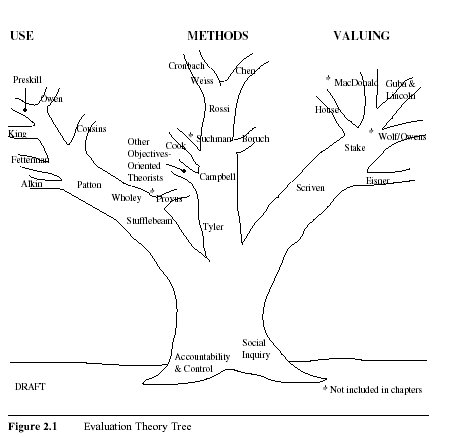
Marvin C. Alkin and Christina A. Christie developed what they call the EVALUATION THEORY TREE. It splits the prominent (North-American) evaluation theorists into three big branches: Theories that focus on the use of evaluation, theories that focus on the methods of evaluation and theories that focus on how we value when evaluating. You can find more information about this at http://www.sagepub.com/upm-data/5074_Alkin_Chapter_2.pdf


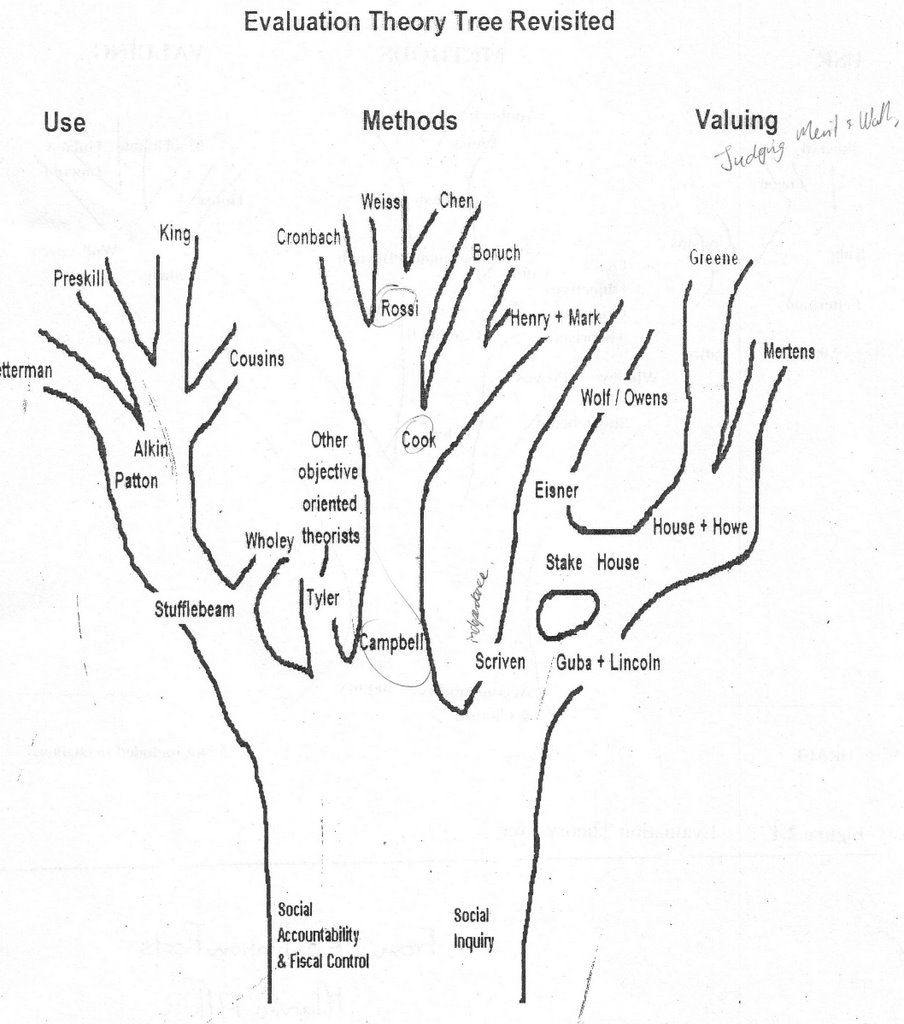
The second tree is a slightly updated version. It was interesting to note that most of my reading about evaluation has been on "Methods" and "Use".

I think that if we are serious about developing our own African evaluation theories, we might need to develop our own African tree. Bob Piccioto mentioned that the African tree might use the branches of the above tree as roots, and grow its own unique branches.


A small commission from the conference put together a call for Action that outlines some key steps that should be taken if we hope to make progress soon. Hopefully I can post this at a later stage.

Keep well!

Thursday, January 25, 2007

UFE & The difference between Evaluation and Research

At the recent AFREA conference I was again reminded of what we are supposed to be doing in evaluation. Consider the word evaluation: It is about valuing something. Valuing for the purposes of accountability and for learning and improvement.

It is not just research, and although some people have indicated that they get irritated with our attempts at distinguishing evaluation from research, I think it is critically important to distinguish between research and evaluation.

Depending on which paradigm you come from, one might argue that research can be the same as evaluation. I don’t argue with that. What I do have a problem with is people approaching evaluations like research projects where the focus is all on “How do we collect evidence?” The methodology is critically important, agreed, and there is nothing that grates me more than seeing how people use poorly designed evaluation methodologies to collect “evidence”.

But evaluation is not just about how we collect information. Evaluation is supposed to take it a step further and make some evaluative judgments based on the data that was collected. Just describing your evaluation findings without saying what it means is senseless.

It is good and well if you find information about the level of maths capacity in rural schools interesting, but an evaluation will also go further and indicate whether the project is relevant, effective, efficient, has an impact and is sustainable or creates sustainable results. Without this additional “Valuing” judgments, an evaluation is only a research project that may increase our knowledge, but don’t help us to make decisions.

Something that may help more evaluations to be true evaluations is the Utilization Focused Evaluation approach of Michael Quinn Patton. It is all about how to ensure that an evaluation serves its intended purpose for the intended users. Go ahead – google Utilization Focused Evaluation and see how many hits come up. It literally is the biggest thing that has hit the Evaluation community in the past 30 years, yet many people are blissfully ignorant of this.

For those who commission evaluations, Patton specifically created a checklist that may be of value in making sure that evaluations are useful. www.wmich.edu/evalctr/checklists/ufe.pdf It might need to be adapted for use in your specific setting, but it definitely asks a couple of pretty critical questions about our evaluations.


Go ahead… I dare you to read up more about UFE (Utilization Focused Evaluation) and not be excited about the possibilities that evaluation has!


Have A good day!

PS. I hope to post some more of my thoughts on the AfrEA conference over the next month or so!

Thursday, January 04, 2007

IOCE

The IOCE is an international organisation for cooperation in evaluation and they have a couple of neat resources on their website:

http://www.ioce.net/resources/reports.shtml

The World Bank's Independent Evaluation Group Finds Progress On Growth, But Stronger Actions Needed For Sustainable Poverty Reduction


The World Bank's Independent Evaluation Group (IEG) is releasing its 2006 Annual Report on Operations Evaluation (AROE)

Joint UNICEF/IPEN Evaluation Working Paper on "New trends in development evaluation"

Resources for Evaluation and Social Research Methods

What Constitutes Credible Evidence in Evaluation and Applied Research? >>

When Will We Ever Learn: Recommendations to Improve Social Development through Enhanced Impact Evaluation

Very very usable Evaluation Journal - AJE

I’ve just paged through the December 2006 issue of the American Journal of Evaluation, and once again I am impressed.

It is such a usable journal for practitioners like myself, whilst still balancing it with the academic requirements that a journal should have. They do this by including

  • Articles – That deal with topics applicable to the broad field of program evaluation
  • Forum Pieces – A section were people get to present opinions and professional judgments relating to the philosophical, ethical and practical dilemmas of our profession.
  • Exemplars - Interviews with practitioners whose work can demonstrate in a specific evaluation study, the application of different models, theories and priciples described in evaluation literature.
  • Historical Record - Important turning points within the profession is analyzed, or historically significant evaluation works are discussed.
  • Method Notes – Which includes shorter papers describing methods and techniques that can improve evaluation practice.
  • Book Reviews – Recent books applicable to the broad field of program evaluation are reviewed.

I receive this journal as part of my membership to the American Evaluation Association – at a fraction of the costs that buying the publication on its own would have.


Go ahead – try it out – Here is a link to its archive:

http://aje.sagepub.com/archive/

Tuesday, December 05, 2006

Log Frame Training - Common Challenges

I recently again facilitated a logframe workshop where I oriented the managers of intervention programmes towards basic log frame concepts and the idea of indicators, targets and means of verification.

Most people seem to intuitively grasp what we are trying to achieve when we present the workshop, and most take well to the assumption that it allows for better planning, monitoring and evaluation, but a set of common challenges seem to arise. In this entry I highlight three of these challenges and give an idea of how I try to get around them. I would be interested to hear from anyone how they approach these.

CHALLENGE 1:
Participants find it difficult to distinguish outputs, outcomes and impacts from one another. Even if we give them plenty of examples, clear definitions and an opportunity to practice their identification of the different kinds of results, they still find it difficult to correctly place these in the results chain. It is not absolutely crucial that they are placed correctly, but it definitely helps when you are later developing and indicators matrix. To help participants, I often give the following explanation
  • Outputs are what your programme delivers and are often a tangible indication that some activity was completed.
  • Outcomes are the changes you hope to see in the behaviour / skill / knowledge / values / attitudes of those you interact with in the shorter term.
  • Impacts are the other organisational and longer term changes you hope to see as a result of changed behaviour / skills / knowledge / values / attitudes of the participants.

And then I demonstrate it with a tomato plant example:

  • Planting tomato seeds, fertilising them and watering the soil are likely to result in a number of green sprouts emerging as a direct result of your "intervention". These aren't yet the tomatoes, but they tell you that you that some activity was completed and that you are possibly on your way to some sort of meaningful result (Output).
  • Having big fat red juicy tomatoes harvested tells you that you have achieved something - the seeds changed into something more useful (Outcome).
  • If you are able to eat your tomatoes and enhance your nutrition or if you sell the tomatoes to supplement your income, these are impact level results (Impact).

CHALLENGE 2:

When participants do a problem analysis they tend to accurately identify the level of intervention required to actually solve a problem. But when it comes to planning the intervention, they loose sight of the magnitude of the problem (despite being encouraged to go back to the problem analysis) and rather focus on the practicalities as it relates to their current organisational strength. So they agree to do two three hour workshops per term because that is all that they can manage. I often have to point them to the example again to get them to understand the effect of this kind of programming:

In the tomato plant example this equates to agreeing to water the tomatoes only once a month because that is all you have the time and staff for. And it obviously could lead to a reduction in the benefits gained.

CHALLENGE 3:

When developing a Log Frame Indicators Matrix, people have great difficulty in ensuring that the indicator , target and means of verification align well.

  • They might talk about the number of something in the indicator and put a percentage in the target. E.g. Indicator: The number of indicators that complete the course. Target: 90% of all Educators
  • They might talk about an increase in performance when they phrase the indicators, but only refer to a single measurement opportunity in the means of verification without any baseline data available. E.g. Indicator: Increase in learner performance on literacy test. Target: 80% of learners must pass. Means of Verification: End of year test

I have used the the following "recipe" with some success.

Appropriate targets if your indicator says something about an
INCREASE / IMPROVEMENT IN
–Number of people with skill / knowledge / appropriate behaviour
*e.g. 20% more people ….
–The knowledge / skill / quality level at which your participants can do something
*e.g. Average knowledge score increases with x%
- The number of people achieving a certain standard increases (e.x. pass, expemption)

* e.g. Number of persons passing increases with 20% over baseline

NOTE If you speak about an increase / improvement in your indicator / target your means of verification presupposes that knowledge about the baseline conditions and at least one other period in time will be required.

Appropriate targets if your indicator says something about achieving a
MINIMUM STANDARD
–Number of people achieving the minimum standard

*e.g. 80% of people must at least pass / get 80%
NOTE: This could be measured at a single instance only

Appropriate targets if your indicator says something about establishing SOMETHING NEW

–Number of people doing / showing something new

* e.g. 125 people must submit a business plan to COMSA
–The frequency with which people do something new

*e.g. Teachers to include open-ended questioning at least once in all observed lessons

Note: This could be measured at a single instance only.